9°


 19 September 2014
Bárðarbunga volcanic eruption
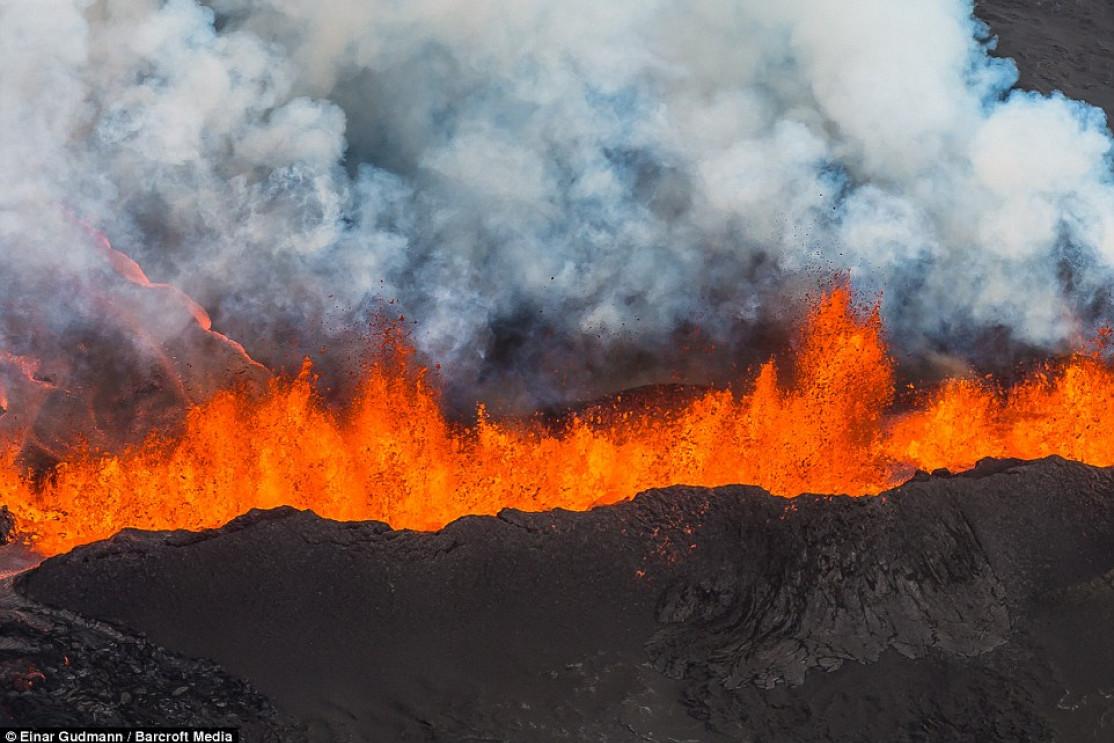
Update: this eruption is now over. It began on 29 August 2014 and the activity at Holuhraun lasted six months, until 27 February 2015. The paragraphs below describe its first weeks. For the full story, the Icelandic Met Office (IMO) has gathered its monthly reports in a dedicated eruption overview.
After a few weeks of earthquakes shaking up the region, the Bárðarbunga volcano south of Askja has woken from its slumber in late August this year. The first sign of this event was a fissure that opened up in Holuhraun, north of Dyngjujökull, issuing smoke and magma.
In less than two weeks the lava flows had advanced over 10 km; by the end of the eruption, the Holuhraun lava field covered more than 85 km², the largest in Iceland since the Laki eruption of 1783-1784. Two additional fissures appeared less than 2 km from the glacier. Here are some links to keep track of the eruption:
- http://laculturevolcan.blogspot.fr
- http://icelandreview.com/news
- http://www.livefromiceland.is
- http://en.vedur.is/earthquakes-and-volcanism/earthquakes/vatnajokull/
- http://baering.github.io/
The eruption in summary
The Holuhraun eruption lasted six months, from 29 August 2014 to 27 February 2015. The lava field covers about 85 km² with a volume of about 1.4 km³, making it the largest effusive eruption in Iceland since Laki in 1783.
Bárðarbunga itself did not erupt visibly: the magma travelled underground for about 45 km before surfacing at Holuhraun, and the volcano's caldera, under the glacier, subsided by more than 50 m (about 65 m in the end) as it drained.
The eruption was mostly remembered for its gas: large amounts of toxic gases degraded air quality in the settlements around the glacier. Since there was no significant ash emission, flights were not disrupted outside the immediate area.
And below are a few impressive videos of the phenomenon, and a bonus video on pronouncing the volcano's name!
Photo credit: Einar Gudman