3°


 07 April 2019
Sprengisandur: Off-road Trail F26
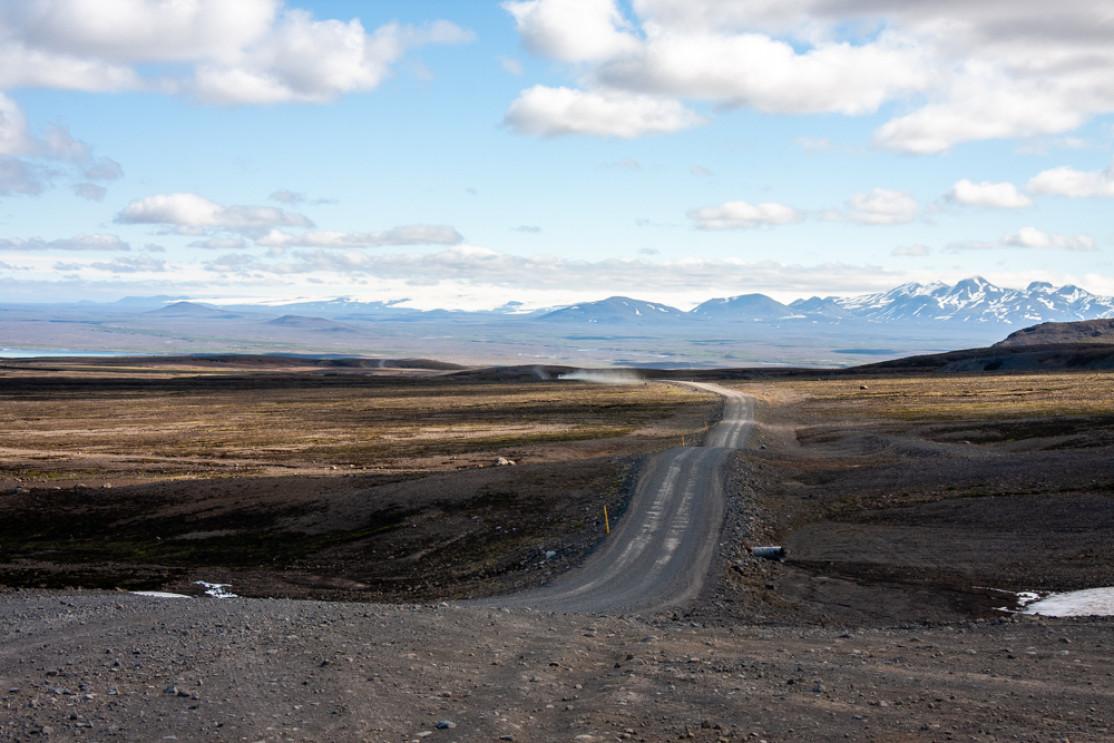
There are two main roads that cut the island South to North, two off-road trails, the better known and the most popular of the two is the Kjölur (F35), and the road less traveled is Road F26 or Sprengisandur.
Like the vast majority of trails that go inland, the F26 is only open in summer, opening up in practice in early July (between 21 June and mid-July in recent years). The exact date inevitably varies depending on weather conditions, so check the Vegagerdin site for up-to-date information:
The F26: A challenging trail

A 4x4 is essential to cross Sprengisandur. This is not a recommendation but absolutely critical, because while the southern leg may be an easy drive, the Nyidalur region will require you to cross fords.
The total trail distance is 250 km or about a 5-hour drive from Hrauneyjar to Aldeyjarfoss. We strongly recommend you refuel strategically in Hrauneyjar, which is the last gas station before the desert. There may be a fuel stop possible near the Versalir barns, but that station isn't always open.
In the north, the first station is at Fosshóll near Goðafoss, so about 235 km separate the two refuelling points (roughly 101 km to Nýidalur, then 134 km onward). There is no fuel at Nýidalur. Treat the Hrauneyjar pump as seasonal and not guaranteed, and carry more fuel than the distance suggests: low speeds, soft surfaces and headwinds push consumption up. Note also that on the official road register the F26 ends at road 842 in the Bárðardalur valley, which then joins the Ring Road at Fosshóll after about 37 km.
Mobile coverage is very patchy in the interior: download offline maps, file your travel plan on safetravel.is and install the 112 Iceland app before you set off.
The F26 trail isn't the most popular road to cut inland, as it's not considered as varied and scenic as the F35 (Kjölur), which also crosses the country on that north-south axis.
The Sprengisandur Desert

Far inland lie the arid desert highlands that stretch between the two impressive Hofsjökull and Vatnajökull glaciers. These desert landscapes were formed by lava flows and layered with volcanic stone and sand.
In good weather, the Sprengisandur drive has some exceptional panoramas, and these ashy deserts have a unique beauty as the clouds paint shadows in every shade of gray over these vast expanses. The weather is variable and volatile in this region of the highlands (between 700 and 800 meters above sea level).
There are some swampy areas with local wildlife, such as geese, ptarmigan, swans, and snow buntings, but in the deserts the fauna becomes a bit sparse as you would expect.
Driving up from the south you can't miss Lake Thorisvatn when you arrive in the region, at 88 km in size simply the largest lake in the country. Like all glacial lakes in the country, it has a superb characteristic green color.
Keep driving north past Versalir until you arrive at Nýidalur, the main shelter in central Iceland with its two huts totaling 54beds. This oasis of greenery in the middle of the Sprengisandur Desert is a welcome stopover. Nyidalur is located 100 km from Hrauneyjar.
Located very close to the Tungnafellsjökull glacier, the Nýidalur valley is also the starting point for many hiking trails, some right up the glacier itself.
On site there is a campsite, a toilet and shower building, a summer warden and Vatnajökull National Park rangers, who are the best source of information on the state of the fords further north. There is no fuel and no food for sale, so bring your own supplies. It is also the only place to stay along the crossing, which makes it a natural stop if you prefer to drive the track over two days.
A few kilometers after Nýidalur there is a ford that you need to be careful crossing; its height varies according to rainfall. This is the only real challenging section, but it can sometimes be too dangerous to pass and vehicles may be forced to turn around.
This ford is called Hagakvíslar. It lies four to five kilometres north of Nýidalur and is the crossing most often blamed when the track is closed. There is no bridge on the F26 between Nýidalur and Dragaleið (F881), and no official source publishes a depth, because glacial rivers change from hour to hour with rain and melt. Before you go in, ask the national park rangers at Nýidalur for advice, judge the ford on the spot, and if in doubt wait for another vehicle or turn back. Smaller 4x4s can struggle after heavy rain or in warm weather.
Check your insurance too: most rental contracts in Iceland, even with extra options, do not cover water damage caused by crossing a river, so repair and towing costs would be entirely yours.
From this point there are various paths leading north: the F910 west to Askja which is considered to be the most complicated track in the country, but there's the F752 to Varmahlíð, the F821 to Akureyri, or you could stay on the F26 towards Goðafoss.
Before reaching Godafoss, however, the trail can get quite tricky, and a stop can be necessary near the Aldeyjarfoss waterfall, with its incredible basaltic organs and vivid green lichen walls.
Other stops are worth a detour: in the south, near Hrauneyjar, the Sigöldugljúfur canyon, reached from the F208; further north, the Hrafnabjargafoss waterfall, less visited than Aldeyjarfoss; and, on the F821 and F752 side, the Laugafell hot spring where you can bathe, at the cost of a detour of a few dozen kilometres driven at low speed.
Follow us