-3°


 19 April 2019
The Kirkjubæjarklaustur Region
Located on the south coast of Iceland between Jökulsarlón and Vik, Kirkjubæjarklaustur is a small village of about 180 inhabitants (the administrative centre of the Skaftárhreppur municipality). Its name, quite complicated to pronounce at first, is often abbreviated to “Klaustur” and literally means “Chapel of the Ladies' Farm”.
It's one of the main attractions for anyone passing through the south, and many excursions start from this point.
- How to get to Kirkjubæjarklaustur
- Kirkjubæjarklaustur: the crossroads of the south
- Things to do in Kirkjubaejarklaustur
- Services and practical information in Klaustur
- Hiking in Kirkjubaejarklaustur
How to get to Kirkjubæjarklaustur
The village lies right on Road number 1 (the Ring Road), about 255-260 km east of Reykjavik. Allow 3 to 3.5 hours of driving without stops. The route passes waterfalls, black sand plains and lava fields. Buses run between Reykjavik and Klaustur, but schedules are limited, especially in winter, and the journey is noticeably longer because of stops and connections. Road 1 stays open all year but can be icy and windy in winter, so check umferdin.is and vedur.is before you set off.
Kirkjubæjarklaustur: the crossroads of the south

Kirkjubæjarklaustur is something of a crossroads in this part of Iceland. Being close to many tourist sites and points of interest, it's become a sort of essential services platform for visitors with a gas station, supermarkets, guesthouses etc...
It's true that there are quite a lot of tourist attractions nearby:
- Edlgja to the North
- Vik to the West
- Jokulsarlon, Skaftafell to the East
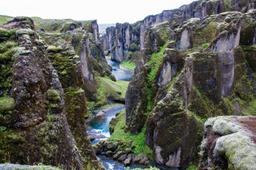
- Fjaðrárgljúfur
- Laki

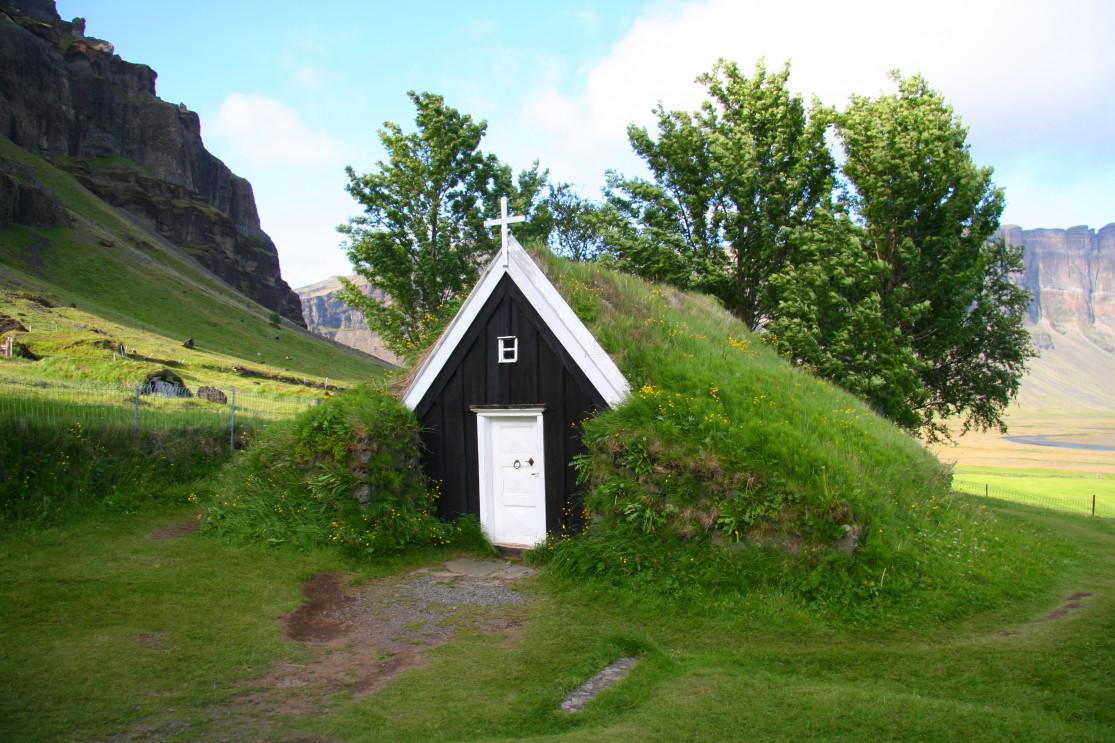
Núpsstaður and the Dverghamrar cliffs are one of the closest and definitely worth visiting. Núpsstaður is a tiny chapel located at the foot of Lómagnúpur dated 1650, and by tiny we mean only a few m².
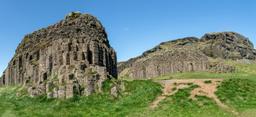
Located east of Klaustur (about 15 km away), south of Road number 1, the Dverghamrar Cliffs ("Dwarf Cliffs") are, as the name suggests, two cliffs of superb basaltic organs carved by maritime erosion and dated around the end of the last ice age.
Photo Credit: Deborah Benbrook @fotolia
Between Vik and Klaustur, Road number 1 crosses the moss-covered Eldhraun lava field, created by the Laki eruption of 1783-1784.
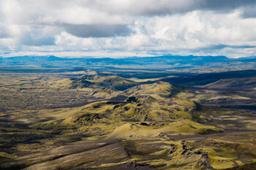
Another volcanic site not to be missed is the Landbrotshólar pseudo-craters, formed around 934 during the Eldgjá eruption. As the lava flowed over a wetland, steam explosions built these hollow cones. To get there, drive 5 to 10 minutes east on Road number 1 from Klaustur, then turn north onto Road 204 (Meðallandsvegur). A flat, easy trail of about 9 km loops around part of the field, starting from the bridge over the Skaftá river and the small lake Hæðargarðsvatn. The moss and soil are fragile, so please stay on the paths and avoid climbing on every crater.
Things to do in Kirkjubaejarklaustur
During the Lakagígar eruption of 1783, the village miraculously escaped a tragic fate when the lava flow was stopped by a rocky promontory now known as Eldmessutangi.
Another popular attraction here is the Kirkjugolf (“church floor”). These basaltic organs have been so perfectly planed by glacial erosion that they have become dead flat underfoot, a most unique phenomenon.
Overlooking the village, there is a waterfall and a lake, both well known to locals: Systrafoss and Systravatn. The beautiful Systrafoss waterfall can be seen from as far as Road number 1 as you are driving into Kirkjubaejarklaustur.
West of the village you will also find Systrastapi (“Sisters' Rock”), a steep, flat-topped rocky hill. Allow about 30 minutes on foot from the village along a marked path that runs through farmland: please stay on the trail, as the land is privately owned. On the way you pass the Rauðárfoss waterfall, where the water and rocks turn a rusty red-brown colour because of the iron-rich soil. Chains are fixed to the rock, but the slope is steep and slippery, so we don't recommend the climb unless you have solid experience.
According to legend, two nuns from the 14th-century convent were executed here for breaking their vows: one had spoken ill of the Pope, the other had made a pact with the devil. After the Reformation, it was said that grass and flowers grew on the grave of the first, but never on the other. The story exists in several versions.
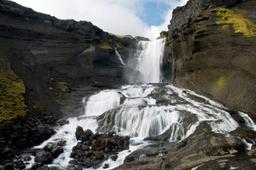
Nearby, a few kilometers east of the city, another waterfall can be seen from Road number 1: Foss á Siðu. The Siðu waterfall comes from Lake Þórutjörn and plunges 30 meters for a spectacular effect as it crashes onto the volcanic stone.
Services and practical information in Klaustur
- Skaftárstofa: the Vatnajökull National Park information centre, located at Sönghóll beside Road number 1, which also serves as the municipality's tourist office. The rangers can advise you on hikes and road conditions, and the "Life with Nature" exhibition explains how locals have lived with the glacier, volcanic eruptions and glacial floods. Opening hours: 9am-5pm from 1 October 2026 and 9am-5:30pm from 1 June (check before your visit).
- The swimming pool (Klausturvegi 4): a main pool, a children's pool and two hot pots, one of which has a direct view of the Systrafoss waterfall. An adult ticket costs 1,100 ISK (price as of July 2026); opening hours vary with the season.
- In the village: toilets, gas station, supermarket, cafés, a hotel, guesthouses, cottages and a campsite. There are no toilets at the foot of Systrafoss, so stop in the village before you set off hiking.
Hiking in Kirkjubaejarklaustur
Several hiking trails are laid out in the area as can be seen on the map, some near Dverghamrar, one further south of Road number 1. But the best known is probably the one starting from the village, leading to the lake and the "church floor".
The total duration of this hike is 1H15. The trail starts at the western end of the village near a wooden fence. The hike is easygoing, despite a fairly steep slope at the start.
The path is well-marked and after some hiking in the forest after the waterfall you arrive at a plateau with a fantastic view of Lake Systravatn. From the top, you can even see Vatnajokull on a clear day.
Follow the trail north-east for just over 1 km until you arrive near a house and the path starts to go downhill. You'll soon come across a car park with signs indicating the "church floor". An easy and fun hike for tourists staying nearby.
This 5 km trail, which starts at Systrafoss, is called Ástarbrautin (“the Love Path”) and passes by Kirkjugólf. At the foot of the waterfall, a forest planted in the mid-1940s has a circular path (Skógarstígurinn) with the little cave Sönghellir, where you can hear a natural echo, and a spruce of almost 30 m, the tallest tree in Iceland.
If you don't have time to walk, Kirkjugólf can also be reached by car: it lies just east of the village, about 500 m from Road number 1. A small free car park is linked to the site by a short, flat path. It is a protected natural monument of about 80 m², so stay on the edges and take care not to damage it.
Wear good shoes: the steps and the trail become slippery in the rain and are often icy in winter, in which case it's better to admire Systrafoss from the car park. Keep away from the edge at the top of the cliff, where rocks can be unstable.